

There is a building on the south bank of the River Aire in Leeds that holds more concentrated martial history than almost anywhere else on earth. I visited on a grey Tuesday in February, and I was not prepared for what waited inside. The Royal Armouries museum opened its Leeds home in 1996, and in the three decades since, it has quietly grown into an institution of genuine global standing. The Royal Armouries Leeds sword collection alone could occupy a serious scholar for a lifetime.
To understand why that collection exists, and why it ended up in West Yorkshire of all places, you need to go back several centuries. The armouries themselves are the oldest museum in Britain, with roots stretching to the mid-sixteenth century when Henry VIII’s weapons were formally organised and displayed at the Tower of London for official visitors. For four hundred years, the collection never moved. Then, in the 1980s, the Tower simply ran out of room.
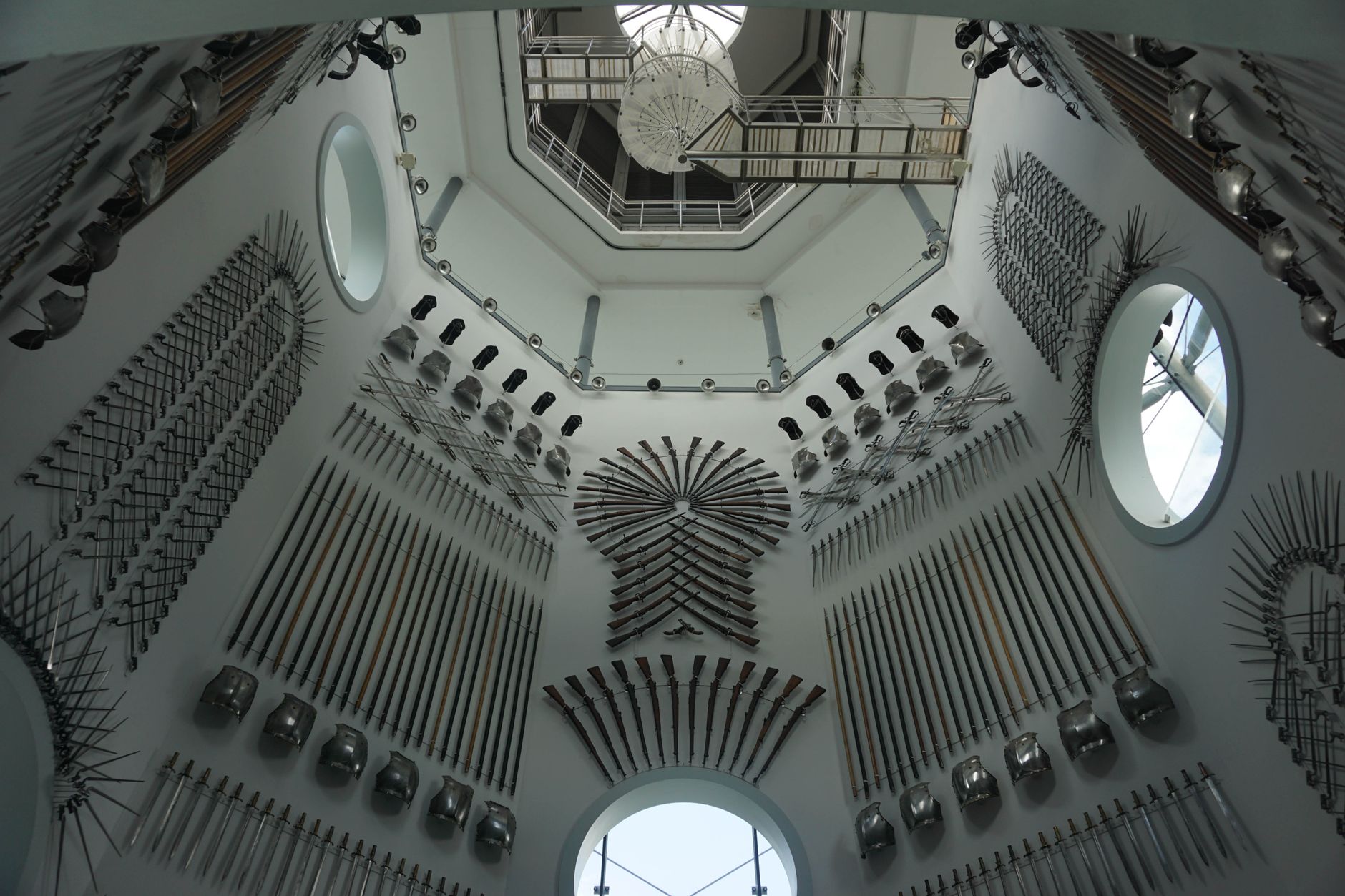
From the Tower of London to the banks of the Aire
The decision to relocate was not painless. Critics argued that stripping arms and armour from the Tower was an act of institutional vandalism, severing an artefact from its natural setting. I have some sympathy with that view. The Tower’s White Tower, with its atmospheric stone galleries, is an extraordinary place to encounter a sixteenth-century sword. But the counterargument is persuasive: the Leeds site gave the collection room to breathe, room to be properly conserved, and room to be explained to audiences who might never have made the journey to central London.
Leeds was chosen after a competitive process involving several cities. The waterfront location on Clarence Dock was central to the pitch, a regeneration site that the museum would anchor. The building itself, designed by Derek Walker Associates, is a bold structure of five interconnected galleries arranged around a central atrium. It is not a shy building. When it opened on 15 March 1996, more than 30,000 people visited in the first fortnight. The city had not seen anything quite like it.
What the sword collection actually contains
The Royal Armouries holds approximately 70,000 objects in total, spanning arms, armour, and artillery from antiquity to the present day. The edged weapons alone number in the thousands, and the range is staggering. Amongst the most significant pieces is a late-medieval English longsword of the type associated with the Wars of the Roses, its blade bearing the kind of weight distribution that reminds you these were working tools, not ornaments. The armouries also hold rapiers of extraordinary delicacy from the Tudor and Stuart periods, their hilts worked in iron and silver with a fineness that rivals any decorative craft of the age.
I spent a long time in front of a seventeenth-century backsword that once belonged to a cavalry officer of the English Civil War period. The blade is not especially long, but there is something in the proportions, the way the grip fills a hand, the slight forward taper of the blade, that communicates function with unsettling clarity. The Royal Armouries curators are good at placing objects like this in context. The wall text does not simply list dates and dimensions; it places a blade within the military tactics, the social hierarchies, and the economic realities of its moment.
The oriental arms holdings deserve separate attention. The collection of Japanese swords, including several tachi and uchigatana from the Muromachi and Edo periods, is amongst the finest in Europe. Comparative collections of this quality in Britain are almost nonexistent outside the Victoria and Albert Museum. For anyone interested in the metallurgical and aesthetic traditions that produced the katana, the Leeds galleries are essential.
Education and living interpretation
What distinguishes the Royal Armouries from a conventional museum is its long commitment to what it calls “living history” programming. The venue employs professional interpreters who demonstrate historical combat techniques, including longsword and polearm forms drawn from surviving medieval fight manuals such as the Fechtbücher of Johannes Liechtenauer. I watched one such demonstration in the Tournament Gallery and found it genuinely revelatory. Seeing a pollaxe move through its proper guards strips away the romance and replaces it with something better: comprehension.
The museum runs a programme of events throughout the year, including its annual Leeds Swordsmanship Symposium and school visits structured around the national curriculum. The Royal Armouries official site lists the full calendar, and I would suggest booking ahead for the more specialist demonstrations, as they fill quickly. For younger visitors, the hands-on elements in the War Gallery are particularly well-designed, children can handle reproduction weapons under supervision, which is exactly the right way to build genuine curiosity about the past rather than passive reverence for glass cases.
There is also a quietly serious academic dimension. The armouries publish research, maintain conservation labs on site, and collaborate with universities across the country. For those interested in the craft side of historical edged weapons, this academic thread connects naturally to the broader revival of traditional British smithing skills. The quiet revival of British bladesmithing happening in workshops across the country draws direct inspiration from the kind of primary source material the Royal Armouries makes accessible to researchers and craftspeople alike.
Why the Leeds location matters beyond the building
The museum sits in a part of England with its own deep martial history. The Wars of the Roses were fought across Yorkshire as much as anywhere; the Battle of Towton, fought on 29 March 1461 and still considered the bloodiest battle ever fought on English soil, took place roughly 12 miles south-west of Leeds. The weapons in those galleries were not abstract objects to the people of this region. They were carried by men who left from these same moors and river valleys.
Admission to the Royal Armouries in Leeds is free, which is a decision the institution has held to since opening. That matters. The collection is publicly funded, in the sense that the nation owns it and the nation should be able to see it without a financial barrier. Roughly 350,000 people visit each year according to the museum’s own published figures, making it one of the most visited free attractions in the north of England.
My honest assessment, after several visits over the years: the Royal Armouries Leeds sword collection is extraordinary not because it accumulates the rarest objects (though some of them are genuinely rare) but because it treats the history of edged weapons as a serious subject deserving serious scholarship, serious interpretation, and serious public access. That combination is rarer than any single blade in the collection.
Frequently Asked Questions
Is the Royal Armouries in Leeds free to visit?
Yes, entry to the Royal Armouries museum in Leeds is free. Some special events and demonstrations may have a separate charge, but the permanent galleries, including the sword and edged weapons collections, are open to all without admission fees.
How did the Royal Armouries end up in Leeds rather than staying at the Tower of London?
The collection outgrew the available space at the Tower of London during the 1980s, and a formal process was held to find a new home for the national arms and armour collection. Leeds was selected partly because of its waterfront regeneration opportunity at Clarence Dock, and the new purpose-built museum opened there on 15 March 1996.
What are the most significant swords in the Royal Armouries Leeds collection?
The collection spans medieval longswords, Tudor and Stuart rapiers, Civil War cavalry swords, and an exceptional range of Japanese swords including tachi and uchigatana from the Muromachi and Edo periods. The oriental arms holdings are considered among the finest in Europe.
Can children and school groups visit the Royal Armouries in Leeds?
Yes, the museum actively welcomes school visits and structures educational programmes around the national curriculum. The War Gallery includes supervised hands-on elements where younger visitors can handle reproduction weapons, and living history demonstrations run throughout the year.
How far is the Royal Armouries from Leeds city centre?
The museum is located at Clarence Dock, roughly a 15-minute walk from Leeds city centre along the waterfront. It is also accessible by bus from the city centre, and there is a car park on site for visitors travelling by car.
Leave a Reply