
The most common mistake about Excalibur is to treat it as one sword with one story: the blade pulled from the stone. It is not. In the Excalibur Arthurian legend, British sword symbolism rests on two separate weapons, and the confusion matters because each one makes a different claim about who has the right to rule.
The sword in the stone proves Arthur’s birthright. Excalibur, in its best-known form, is a gift from the Lady of the Lake. One says you inherit authority, the other says it is bestowed. The tradition has spent eight centuries holding both ideas at once.

Are the sword in the stone and Excalibur the same sword?
No. They are different weapons that were merged in popular memory, mostly by retellings and films. In Sir Thomas Malory’s Le Morte d’Arthur, finished in the 1460s and printed by William Caxton in 1485, Arthur draws a sword from a stone to prove he is king. Later he breaks that blade in combat and is given Excalibur by the Lady of the Lake.
Earlier writers disagree with one another, which is part of the story. Malory himself is not consistent about which sword is which in places, and the French romances he drew on arranged the episodes differently. The tidy single-sword version is a modern simplification.
Where does Excalibur come from?
Excalibur begins with Geoffrey of Monmouth’s Historia Regum Britanniae, written around 1136. There the king’s sword is called Caliburnus, said to have been forged on the Isle of Avalon. Geoffrey presents it as a fine weapon, not a magical one, and gives it no stone and no lake.
The name probably owes something to older Welsh tradition, where a sword called Caledfwlch appears in early Arthurian material such as the tale Culhwch and Olwen. Geoffrey’s Latin form then travelled into Norman French and English as Excalibur. That path, from Welsh tale to Latin chronicle to French romance, is why the sword feels both deeply British and thoroughly European.
How did the legend change between Geoffrey and Malory?
The sword gained a supernatural origin and a moral meaning. Geoffrey’s Caliburnus is simply an excellent weapon. By the time French romancers such as Robert de Boron and the authors of the Vulgate Cycle had finished, the story involved a stone, a divine sign, a lady in a lake and a scabbard that prevented its bearer from bleeding.
Malory gathered these strands into English prose. His Arthur does not seize power. He is chosen, and the sword is the evidence. That framing, authority proved by an object rather than argued by lawyers or won by armies, is what gave the legend its lasting political appeal.
Why does the sword mean legitimate authority?
Because in medieval Europe the sword was already a sign of lawful power, and the Arthurian story attached it to a single, memorable proof. A king was girded with a sword at coronation, and the blade stood for the duty to defend the realm and uphold justice. English coronations still include a sword presentation, and the Sword of State is carried before the monarch at the State Opening of Parliament.
Arthur’s story adds something those ceremonies lack: a test that cannot be rigged. Nobody can argue with a sword that will not move for anyone else. Rulers who wanted to borrow that certainty were happy to do so. Edward I is recorded as visiting Glastonbury in 1278 when a grave said to be Arthur’s was reopened, and the Tudors made much of Arthurian descent. Henry VII named his first son Arthur.
How do modern films and novels use Excalibur?
They treat it as shorthand for rightful leadership, and they often adjust the meaning to suit the age. T. H. White’s The Once and Future King, first published as a single volume in 1958, turns Arthur’s reign into a meditation on might and right, with the sword as the burden of power. John Boorman’s 1981 film Excalibur makes the blade almost mystical, tied to the land itself.
Lighter versions follow the same pattern. Disney’s 1963 The Sword in the Stone reduces the legend to a boy’s lesson in humility, while Guy Ritchie’s 2017 King Arthur: Legend of the Sword recasts it as a street-level struggle against a usurper. Every version keeps the core idea that the sword chooses, and that the wrong hand cannot hold it.
Is Excalibur really a British symbol?
Largely yes, though with caveats. The story was shaped by Welsh, Breton, French and English writers, and Arthur was claimed by all of them. Yet since Malory, and through the Victorians’ revival in Tennyson’s Idylls of the King, it has been treated as an English-language national inheritance. Sword imagery in British public life, from regimental badges to civic regalia, sits comfortably in that shared memory.
The real sword behind the myth is a different matter. No historical Arthur has been proved, and no surviving blade is Excalibur. The power of the symbol comes from the story, not from any artefact, which is why it has survived so many rewritings.
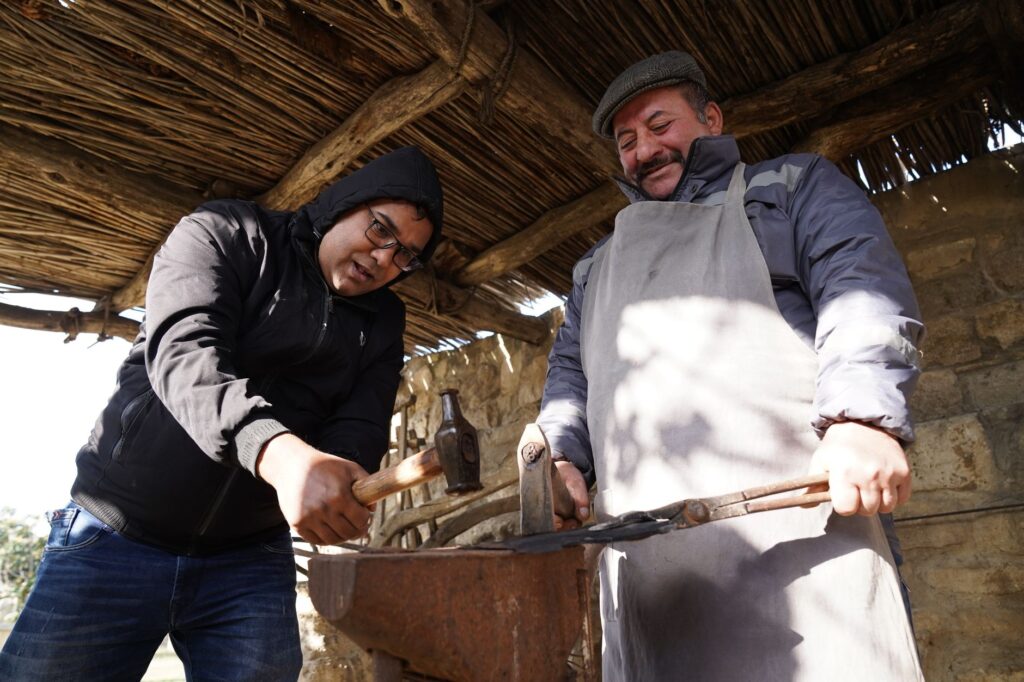
If you want to see how real swords were made in the age that produced these tales, our piece on the revival of British bladesmithing is a good next read. For the texts themselves, the British Library holds major medieval manuscripts and its online resources are a sound starting point.


Leave a Reply