

British sword law is badly drafted, but it is workable, and most collectors who get into trouble do so by ignoring three rules they could have learnt in an afternoon. Under UK sword ownership law in 2026, owning a sword at home is generally lawful. Selling one, importing one or carrying one in public is where the criminal law bites.
I would argue that the confusion is the real danger. Parliament has legislated by lists and exemptions for decades, and the result reads like a puzzle. Take it piece by piece and the logic emerges.
What does the Criminal Justice Act say about swords?
Section 141 of the Criminal Justice Act 1988 makes it an offence to manufacture, sell, hire, lend or give away, or to import, any weapon listed in a ministerial order. The Criminal Justice Act 1988 (Offensive Weapons) Order 1988 lists a sword with a curved blade of 50 centimetres or more. That is the category that catches most katana-style and scimitar-style blades. A straight-bladed arming sword or a rapier is not on that list, which is a distinction many buyers never learn.
Note what the section targets: dealing, not keeping. A person who already owns a listed sword is not committing an offence merely by having it in a cupboard. The trouble starts when it changes hands, crosses the border or goes online.
Which swords are exempt: antiques, handmade and martial arts?
Swords are exempt from the section 141 ban in several defined cases. The best known is the antique: later orders fixed this at weapons made before 1954. A second exemption covers swords made by traditional methods of forging, with the blade heated and hammered by hand, rather than cut from sheet or bar by machine. Further exemptions exist for museums, theatrical and re-enactment use, religious use and martial arts.
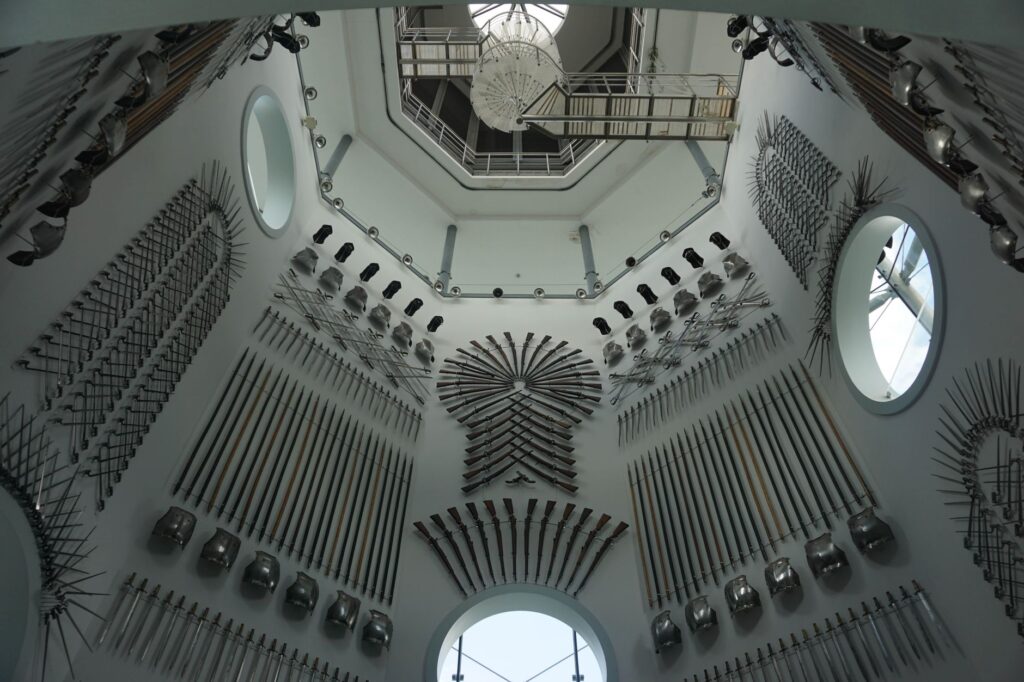
Here is my honest view of the antique rule: it is the sensible part of the law. A Victorian cavalry sabre or a Japanese blade of real age is a historical object, and the law mostly treats it as one. The Royal Armouries in Leeds, which I have written about in the story of its edged-weapon collection, holds such pieces precisely because they are history, not menace.
The handmade exemption is the weak point. Sellers love to claim it, and the burden of showing an exemption in practice falls on the person relying on it. A cheap reproduction advertised as hand-forged is a risk for the buyer as much as the seller. Keep invoices, makers’ details and any dating evidence.
What did the Offensive Weapons Act 2019 change?
The Offensive Weapons Act 2019 tightened the rules for bladed articles, mostly in two ways. It made it an offence to possess certain prohibited weapons even in private, and it tightened remote sales of bladed products. A seller who sells a bladed article online must have age verification in place, and delivery to a residential address is restricted unless the seller has taken the steps the Act requires. The Act is aimed principally at knives, but it sits within the same framework as swords, and online sellers treat it as covering them.
The practical lesson is that a sword bought through a website is still a regulated purchase. If you are under 18, you cannot lawfully buy one. If you are a seller, the checks are your responsibility, not the courier’s.
Can you carry a sword in public?
Carrying a sword in public without good reason is a criminal offence in England and Wales. Two statutes do the work: the Prevention of Crime Act 1953, which covers any offensive weapon in a public place, and section 139 of the Criminal Justice Act 1988, which covers any article with a blade or sharp point. Section 139 provides defences of good reason or lawful authority, and it names work, religious reasons and national costume among them.
Transporting a sword to a re-enactment, a martial arts class or a museum loan can be a good reason. But it is a defence, raised after you have been stopped, and a court will ask whether your story is credible. Pack it wrapped, in the boot, travelling directly, and carry proof of the event. Never leave a blade on a car seat.
Scotland and Northern Ireland have their own statutes, and the details differ. The Civic Government (Scotland) Act 1982 governs carrying north of the border, so do not assume the English rules apply.
The obvious objection
Some will say all this is heavy-handed for a hobby that is overwhelmingly harmless. There is something in it: a re-enactor with a replica longsword poses little threat to anyone. But the law is blunt because enforcement needs bright lines. A police officer cannot assess a person’s sincerity at the roadside, and a curved blade over 50 centimetres is easy to measure. I think the lines are crude yet defensible, so long as the exemptions are applied with common sense.
A sensible checklist before you buy or sell
- Measure the blade. A curved blade of 50 centimetres or more is the red flag.
- Establish whether an exemption applies, and keep proof: dating evidence for antiques, maker documentation for handmade pieces.
- Never sell or post a listed sword on the strength of an exemption you cannot demonstrate.
- Use a seller who verifies age and explains delivery conditions.
- Transport blades securely and never carry them in public without a documented reason.
The Government publishes a plain summary of the rules at GOV.UK on buying and carrying knives and bladed articles. Orders change, so check it, or take advice from a specialist solicitor, before any sale involving a curved blade.



Leave a Reply